How the Brauni AI helps you complete session notes in minutes
You finish a session. It was 50 intense minutes. Your patient made important advances and you have a head full of clinical observations. Now comes the part that no psychologist enjoys: sit down to complete the field-by-field session note.
What if you could just talk, like you were telling a colleague what happened in the session, and that the note was completed by itself?
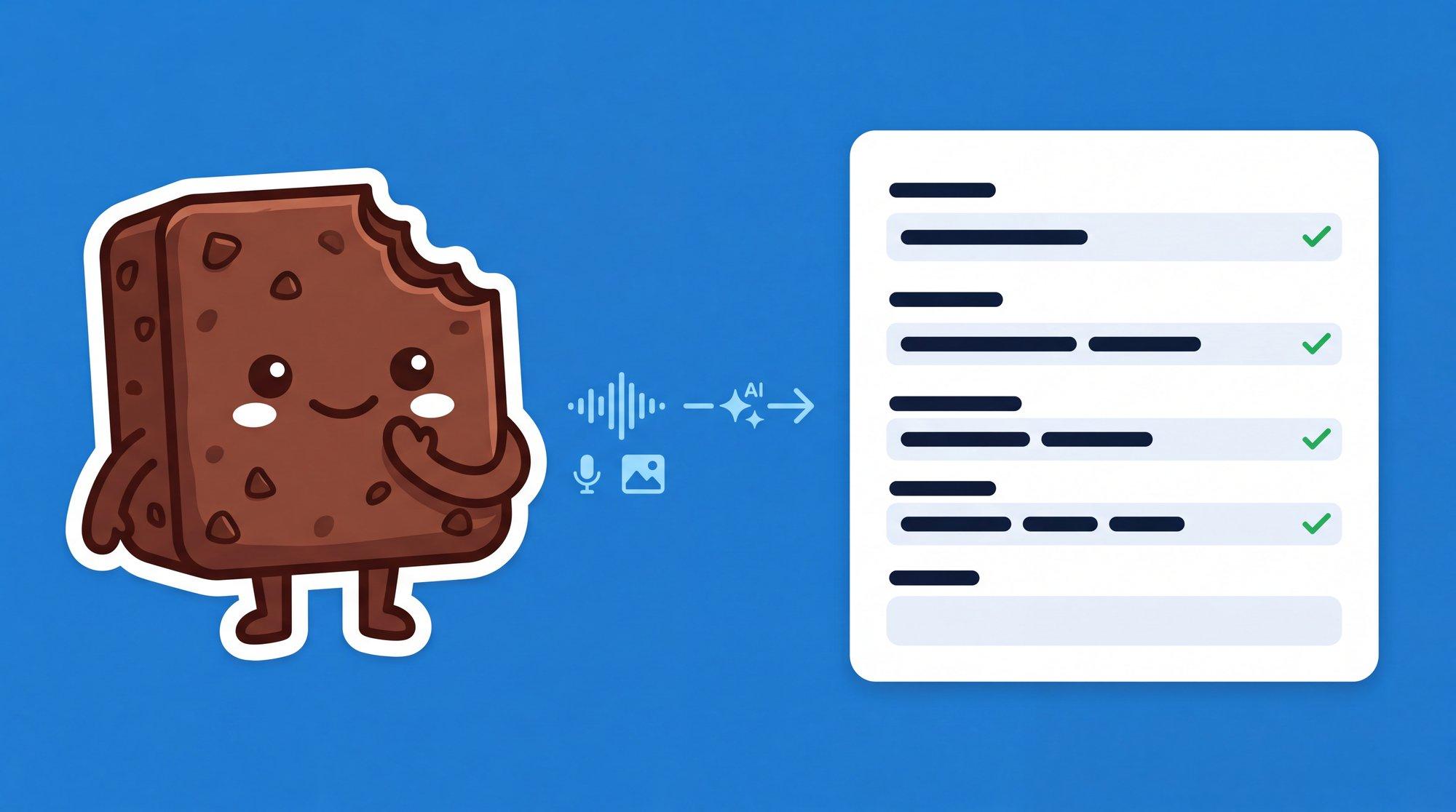
In Brauni, that's exactly what happens. You can send a audio, photo of your notes on paper, or simply write a free summary, and AI is responsible for extracting relevant clinical information and completing each field of your session note. All adapted to your therapeutic orientation and the context of your patient.
Three ways of documenting: you choose
Audio: Speak and get ready
After a session, record an audio describing what happened. It can be from your cell phone, computer, or any device. You don't need to be structured or formal - speak as you would tell a supervisor.
The AI automatically transcribes your audio and extracts the relevant information for each field of the note. It supports files in format WebM, OGG, MP3 and WAV up to 25 MB, sufficient for multi-minute recordings.
Example: You record an audio of 2 minutes saying:
"The patient arrived quite anxious today, shaking a bit. We worked diaphragmatic breathing techniques during the first 20 minutes. Then we could talk about the conflicts with his boss that we had left pending last session. At the end of the session I was much calmer. I left him as a task to practice breathing 5 minutes per day before sleeping."
The AI automatically extracts:
| Field | Extracted value |
|---|---|
| Emotional status at the beginning | Anxious, trembling |
| Interventions | Diaphragmatic breathing techniques |
| Topics worked | Labour disputes (with chief), continuation of previous session |
| Emotional state at close | Much quieter. |
| Intersession tasks | Breathing 5 min/day before bedtime |
Photos: your notes on paper, digitized
Do you take notes by hand during the session? Take a picture of your notebook and upload it. AI reads your handwritten notes and turns them into structured fields.
You can upload up to 5 images per message, ideal if you have notes on multiple pages or if you included diagrams, scales or thought records that the patient completed during the session.
Text: I wrote a free summary
If you prefer to type, I simply wrote a summary in natural language. You do not need to follow any format. AI interprets your text and distributes the information in the relevant fields.
And best: you can combin formats. send an audio with the general summary, then upload a photo of the patient's thoughts record and add a written comment with an observation that you forgot to mention. AI integrates everything into a single coherent note.
Council
You don't need to be exhaustive in a single message. You can add information in multiple conversation quotes and the AI is updating the fields in real time.
The AI knows how you work
Here is the fundamental difference with any other automatic transcription or completion tool: Brauni AI knows your therapeutic orientation.
When you set your profile in Brauni, you define your theoretical approach, your working methodology and your professional experience. This information is injected as a context in each interaction with AI. If you want to understand in detail how this context system works, we explain it in this article.
How does extraction change according to your orientation?
If you work with TCC: AI prioritizes identifying automatic thoughts, cognitive distortions, restructuring techniques, behavioral tasks and activity records. It actively seeks mood scales, evidence for and against beliefs, and exposure techniques.
If you work with a psychoanalytic approach: AI focuses on associative material, transferable content, observed resistances, performed interpretations and dream material if any. Pay attention to latent discourse and analyst interventions.
If you work with a systemic approach: AI identifies relational dynamics, alliances, coalitions, communicational patterns and genograms mentioned. It seeks changes in the family or partner system.
If your approach is integrative: AI combines elements from multiple theoretical frameworks according to what you describe. If in one session you used mindfulness techniques and in another you worked with gestaltic techniques, AI adapts to each case.
Note
Adaptation is not a rigid filter. AI interprets your professional description flexibly and applies it when extracting information. If you mention anything outside your usual orientation, it also includes it - it does not rule out relevant clinical information.
Fields completed in real time
While you talk, write or upload photos, the fields in your session note are being completed in real time via streaming. You see each field fill instantly, without waiting for the entire processing to end.
The fields depend on your session note template - which is completely customizable - but a typical template includes:
- Participants of the session
- Emotional state at start and close (scale or text)
- Main themes worked
- Interventions and techniques used
- Clinical observations
- Tasks and intersession agreements
- Follow-up to previous session tasks
- Encouragement level (selection scale)
- Planning for next session
The AI respects the constraints of each field. If a field is "selection" type with fixed options (such as "Very good", "Good", "Normal", "Mal", "Very bad"), the AI chooses the option that best corresponds to what you described. If a field is "scale" type from the 1 to the 10, assigns a number within the range. It never invents options that do not exist.
Patient context: do not start from scratch
AI not only knows how you work - it also knows your patient. When you complete a note, the system automatically gives context about:
- Name, age and gender of the patient
- Diagnosis Current
- Session number (not the same session 3 as 40)
- Modality (presential or remote)
- Duration of the session
- Previous session tasks (to follow up)
This means that if you say in your audio "today we take back what we have left pending", the AI knows that it refers to the tasks of the previous session and connects them.
You have final control.
It is important to clarify something: the AI completes fields, you approve them. The flow is:
- Send your input (audio, photo, text or combination)
- The AI completes the fields in real time
- You check every field and adjust what you need.
- You keep the note when you're okay.
You can edit any field after the AI completes it. You can delete a field that the AI incorrectly filled in. You can add information that the AI did not capture. The final result is always your note, with your professional judgment.
Note
You can always edit your notes, even those already saved. What AI cannot do is modify them on its own - only act when you ask it to complete fields. Editorial control is always yours.
How much time do you save?
The documentation of a typical session takes between 10 and 20 minutes when done manually. With the AI wizard, the process is reduced to:
- 2 minutes of audio describing the session
- 30 seconds by reviewing and adjusting completed fields
- Ready. Note is saved, encrypted and with all structured fields
That's a 75-85% saving of documentation time. In a week of 20 patients, it's between 3 and 5 hours you'll recover.
Free Brauni test for 30 days, no card
Automatic session notes, digital medical records and more.
Start for freeSecurity at every step
All AI processing meets the same safety standards as the rest of the platform:
- Your audio is not stored on third-party servers - it is transcribed and the result is encrypted
- Notes are saved encrypted with Fernet (AES-128) and the platform adds protection with rest encryption and TLS 1.3 in transit
- Only you can access the notes of your patients (validation of ownership in each operation)
- All activity is audited: who created the note, when, from where
- Data is never used to train AI models - processing is temporary and disposable
For more details on how we protect your information, read our article on security and privacy in Brauni.
Beyond the session notes
The same intelligent completion system works for other clinical forms:
- Patient Profiles: Describe the patient and the complete AI reason for consultation, work situation, history and more
- Clinical Stories: AI extracts relevant information from your descriptions and organizes it in your template structure
And all these forms use dynamic templates that you can customize to fit exactly your way of working.
Your voice, your judgment, your note
The Brauni AI does not replace your clinical judgment. What it does is remove the mechanical part of the documentation - that daily time you spend typing fields that you already have clear in your head.
Speak as you speak. I wrote as you wrote. Write down as notes. AI takes care of the rest.
Everything that includes functionality is in session notes with AI.
The Note Completion Assistant uses Google Gemini via Vertex AI. Clinical data is processed under strict safety protocols and is never used to train artificial intelligence models. Clinical fields are encrypted with Fernet (AES-128) and also operate on secure infrastructure with rest encryption and TLS 1.3 in transit. Brauni complies with the principles of Personal Data Protection Act 25.326.
Related articles
Clinical Technology
How the Brauni AI understands your way of working as a psychologist
Find out how Brauni's AI assistant adapts to your therapeutic orientation, your patients, and your professional style without you having to set up anything.
Professional practice
Notes SOAP, DAP and BIRP: what format to use in your session notes
Note Guide SOAP, DAP and BIRP for psychologists: each format explained field by field, with comparable examples, table and templates ready to copy.

Based on Evidence
AI in mental health: what the evidence shows and where the boundaries are
The first randomized trial of a generational AI chatbot for mental health gave promising results, but other studies show serious failures. What research says today.